

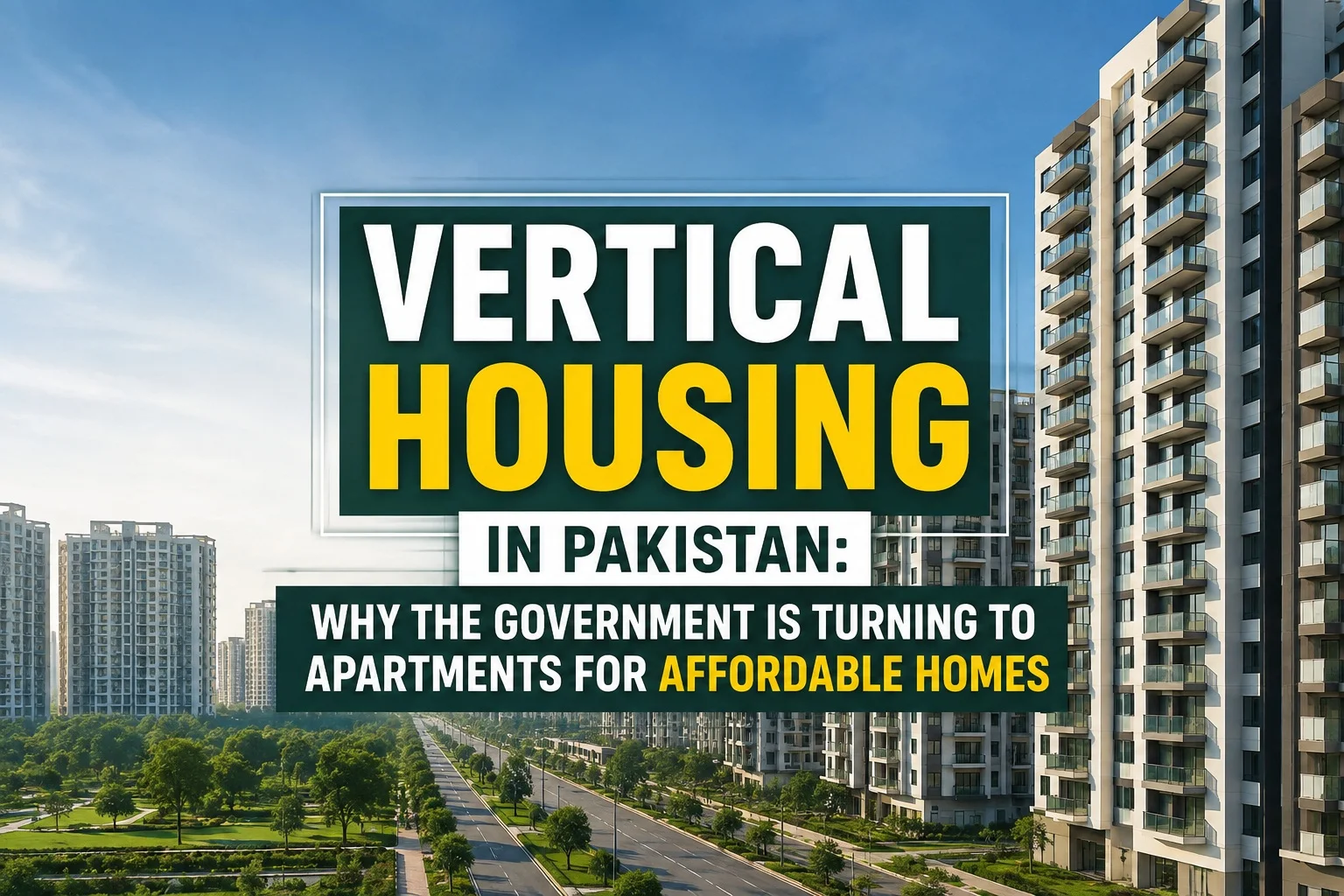
Pakistan is changing the way it thinks about housing. For years, housing development largely focused on plots, single-family houses and expanding cities outward. But rising land prices, rapid urbanisation and increasing demand for homes are making this model harder to sustain.
The government is now giving greater attention to vertical housing in Pakistan, particularly apartments and multi-storey residential developments.
This shift has gained fresh momentum after the federal cabinet approved the National Housing Policy 2026, which prioritises vertical development and energy-efficient construction.
But what does this actually mean for ordinary homebuyers? And can apartments really make affordable housing more accessible?
What Is Vertical Housing?
Vertical housing means developing residential units in multi-storey buildings rather than constructing individual houses across large plots of land.
Instead of using one plot for one family, an apartment building can provide homes for many families on the same piece of land.
For example, a residential building with several floors can contain dozens of apartments while occupying a much smaller land footprint than dozens of separate houses.
This makes vertical development particularly useful in crowded and rapidly growing cities.
Why Is Pakistan Moving Toward Apartments?
The main issue is simple: urban land is limited and becoming more expensive.
Cities such as Lahore, Karachi, Islamabad, Rawalpindi and Faisalabad continue to attract residents because of employment, education and business opportunities.
As cities expand, affordable land becomes harder to find close to established urban areas. Traditional housing can therefore push new developments farther toward the outskirts.
Traditional housing can therefore push new developments farther toward the outskirts. That creates another problem. People may find cheaper houses or plots outside the city, but they can face longer commutes and higher transportation costs.
Vertical housing offers another approach: build more homes within existing urban areas where infrastructure and services are already available.
National Housing Policy 2026 Puts Vertical Development in Focus
The government’s latest housing policy provides an important reason for the renewed interest in apartments.
The federal cabinet approved the National Housing Policy 2026 on August 11, 2026. The policy aims to promote adequate, affordable and sustainable housing while encouraging better use of limited urban land.
Vertical development is one of the policy’s key directions.
The policy also focuses on areas such as:
- Affordable housing
- Housing finance
- Land availability
- Urban development
- Energy-efficient construction
- Building materials
- Infrastructure
- Zoning and planning
This means the government is not simply promoting apartments as a property trend. It is positioning vertical housing as part of a wider housing strategy.
SBP Also Calls for Greater Focus on Vertical Housing
The State Bank of Pakistan has recently highlighted the importance of vertical housing in addressing the country’s housing needs.
The central bank’s call comes as the government works to expand affordable housing finance and increase access to homeownership.
This is important because housing policy and housing finance need to work together. Building apartments does not solve the affordability problem if families cannot obtain financing to purchase them.
Can Apartments Actually Be More Affordable?
This is one of the most important questions for homebuyers. Vertical housing can improve affordability, but an apartment is not automatically affordable simply because it is smaller than a house.
The potential advantage comes from land efficiency. When many homes are developed on one site, the cost of land can be distributed across multiple residential units. Shared facilities can also reduce the need to provide separate infrastructure for every household.
For buyers, this could create an opportunity to purchase a smaller property in a developed urban location instead of buying a larger plot on the outskirts.
However, the final price still depends on:
- Land cost
- Construction expenses
- Financing rates
- Building quality
- Location
- Development charges
- Parking and maintenance costs
- Government regulations
Therefore, vertical housing should be viewed as a tool for improving affordability, not a guarantee of low prices.
How PM Apna Ghar Can Support Apartment Buyers
Housing finance is another important part of the government’s strategy. The Wazir-e-Azam Apna Ghar Program – Ghar Ho Tu Apna covers the purchase of houses and flats, along with other eligible housing options.
According to the Ministry of Housing and Works, eligible buyers can obtain financing of up to Rs10 million, while flats up to 1,500 square feet are covered under the programme. The scheme also provides a fixed customer/end-user rate of 5 percent, subject to its conditions.
This matters for apartment buyers because the cost of a flat may still be difficult to pay upfront. Housing finance allows eligible buyers to spread the cost over time.
This matters for apartment buyers because the cost of a flat may still be difficult to pay upfront. The PM Apna Ghar Scheme provides eligible buyers with financing options that can make homeownership more manageable, while its eligibility requirements and application process are explained in our complete guide to the PM Apna Ghar Scheme for homebuyers. Recent developments under the programme also show growing attention to private developer-led housing projects and affordable vertical living.
Recent developments under the programme also show growing attention to private developer-led housing projects and affordable vertical living.
What Does Vertical Housing Mean for Middle-Income Families?
For many middle-income families, buying a house in a central urban location has become increasingly difficult. A plot may require a large upfront investment. Construction then requires additional money for materials, labour and finishing.
An apartment can offer a different route. Instead of purchasing land and constructing a complete house, buyers can purchase a ready or under-construction residential unit. This can make the buying process simpler.
It may also allow families to live closer to workplaces, schools, hospitals and commercial areas. However, buyers should compare the total cost of ownership, not just the apartment’s advertised price.
Monthly maintenance charges, parking costs, utility arrangements and loan payments can all affect affordability.
Vertical Housing Could Reduce Pressure on Urban Land

One of the biggest benefits of vertical development is its efficient use of land. Imagine two developments with the same number of families.
A horizontal development may require a much larger area because every house needs its own plot. A vertical project can place many apartments within one building.
This can help cities accommodate population growth without continuously consuming land on their edges.
It can also support more compact urban planning when apartments are developed alongside roads, public transport and essential services.
But There Are Risks Too
The shift toward apartments should not be treated as a perfect solution. Poorly planned vertical housing can create serious problems.
Infrastructure pressure
A large apartment project requires reliable electricity, water, sewage and waste-management systems. If infrastructure is not upgraded, a high-density development can put additional pressure on existing services.
Parking and traffic
More residents mean more vehicles unless suitable public transport and parking arrangements are available. This is why apartment projects need proper planning rather than simply increasing building height.
Construction quality
Affordability should not come at the expense of safety or construction quality. Buyers need confidence that buildings meet relevant structural and safety standards.
Project delays
Government-backed and private housing projects can face delays because of financing, approvals, construction or administrative issues.
Therefore, buyers should investigate the developer, approvals and expected completion timeline before making a decision.
What Should Buyers Check Before Purchasing an Apartment?
If vertical housing becomes more popular, buyers will have more apartment options. But more options also mean buyers need to be careful.
Before purchasing an apartment, check:
1. Legal approval
Confirm that the project has the required approvals from the relevant authority.
2. Location
Consider access to roads, public transport, schools, hospitals and workplaces.
3. Developer record
Research the developer’s previous projects and delivery history.
4. Total cost
Don’t look only at the advertised price. Calculate registration, parking, maintenance and financing costs.
5. Construction quality
Ask about building materials, structural standards and facilities.
6. Possession timeline
For an under-construction project, understand when possession is expected.
7. Resale and rental demand
Consider whether people are likely to want to live in the area in the future. These checks can help buyers avoid choosing an apartment simply because it appears inexpensive.
Will Vertical Housing Change Pakistan’s Property Market?
The increasing focus on apartments could gradually change buyer preferences. Some families may continue to prefer traditional houses because they offer more privacy, outdoor space and control over the property.
Others may choose apartments because they offer a lower entry price, central locations and shared facilities. For investors, the changing housing pattern could also create opportunities in the apartment segment.
If more people choose apartment living, demand for well-located residential units could increase. However, investors should focus on real demand rather than simply following the trend.
An apartment in a poorly connected area may not perform as well as one located near employment centres, transport links and essential services.
What Comes Next for Vertical Housing in Pakistan?

The government’s latest policy direction suggests that vertical housing will become increasingly important in Pakistan’s urban development.
The combination of the National Housing Policy 2026, housing finance initiatives and greater attention from the State Bank of Pakistan provides a stronger foundation for apartment-based development.
But successful implementation will matter more than policy announcements.
Pakistan needs apartments that are:
- Affordable
- Legally approved
- Safe
- Well connected
- Properly maintained
- Supported by adequate infrastructure
- Accessible through realistic housing finance
Frequently Asked Questions (FAQs)
1. What is vertical housing in Pakistan?
Vertical housing refers to residential development in multi-storey buildings where multiple families live in separate apartments within the same structure. It allows cities to provide more housing while using less land than traditional single-house developments.
2. Why is the government promoting vertical housing in Pakistan?
The government is promoting vertical housing to address growing urban housing demand, rising land costs and limited space in major cities. The National Housing Policy 2026 also places greater emphasis on vertical development and efficient use of urban land.
3. Can apartments make housing more affordable in Pakistan?
Apartments can potentially improve affordability because multiple homes can be developed on a single plot, reducing the amount of land needed per household. However, the final price also depends on construction costs, land prices, financing and location.
4. Does the PM Apna Ghar Programme provide financing for apartments?
Yes. The PM Apna Ghar Programme supports eligible applicants seeking financing for houses and flats. The programme includes specific financing and property-size conditions, so buyers should check the latest official eligibility requirements before applying.
5. What are the benefits of vertical housing for Pakistani cities?
Vertical housing can help cities accommodate more residents on limited land. It can also support more compact urban development and potentially provide residents with better access to employment, schools, healthcare, transport and other services.
6. What are the challenges of vertical housing in Pakistan?
Major challenges include high construction costs, infrastructure capacity, parking, traffic, building quality, project delays and affordability. Successful apartment development requires proper planning, reliable utilities and effective implementation of building regulations.
7. What should buyers check before purchasing an apartment in Pakistan?
Buyers should verify the project’s legal approvals, developer reputation, location, construction quality, possession timeline and total cost. They should also consider maintenance charges, parking, utilities, financing costs and future resale or rental demand.
Conclusion
The growing focus on vertical housing in Pakistan is not simply about constructing taller buildings. It is about finding a practical way to provide more homes as cities become crowded and urban land becomes more expensive.
Apartments can help use limited land more efficiently and may give middle- and lower-income families another route toward homeownership.
The government’s latest housing policy provides fresh momentum to this approach, while housing finance programmes can help eligible buyers afford residential units.
For readers, the key point is simple: vertical housing could become an important part of Pakistan’s affordable housing future, but affordability will depend on land prices, construction costs, financing, infrastructure and effective implementation.
For homebuyers, this means apartments may offer new opportunities but careful research will remain essential before making a property decision.


