

Infrastructure plays a major role in shaping real estate markets. New roads, highways, public transport, airports, utilities, and commercial developments can make an area more accessible, convenient, and economically active. As demand increases, nearby property values may also rise. This is why infrastructure projects increase property values by improving connectivity, attracting investment, and supporting long-term development.
However, infrastructure does not automatically increase every property’s price. The impact depends on factors such as location, accessibility, project quality, surrounding development, buyer demand, and the type of infrastructure being introduced.
For property buyers and investors, understanding the relationship between infrastructure projects and property values can help identify areas with stronger long-term potential.
What Are Infrastructure Projects?
Infrastructure projects are developments designed to improve the physical and economic functioning of an area. They can include roads, bridges, highways, interchanges, public transport systems, airports, railway networks, water supply systems, electricity networks, hospitals, schools, and other public facilities.
Among these, transportation infrastructure often has a particularly visible effect on real estate because it changes how easily people can travel between residential areas, workplaces, commercial centers, and other important destinations.
Research from Pakistan, for example, found that proximity to the M-9 Motorway was associated with changes in residential property prices, rents, and land development in a studied area of Bahria Town Karachi.
1. Better Connectivity Makes Properties More Attractive
One of the biggest ways infrastructure projects increase property values is by improving connectivity.
When a new road, highway, interchange, bridge, or public transport route reduces travel time, an area can become more attractive to buyers and tenants. People generally prefer locations that provide convenient access to workplaces, schools, shopping areas, healthcare facilities, and major business districts.
Improved accessibility can therefore increase demand for residential and commercial properties.
Recent research on the Mumbai Trans Harbour Link found that properties closer to the infrastructure experienced higher price increases after the bridge opened. The study also found evidence that some price effects began during the construction period, suggesting that expectations about future accessibility can influence property markets before a project is completed.
2. Reduced Travel Time Can Increase Property Demand
Travel time is an important consideration when people choose where to live.
Suppose a new road reduces a 40-minute journey to an employment center to 20 minutes. Even if the property itself has not changed, its practical value to residents may increase because commuting becomes easier.
This can attract:
- Homebuyers looking for convenient locations
- Tenants seeking shorter commutes
- Businesses searching for accessible commercial space
- Investors expecting future demand
As more people become interested in an area, competition for available properties can increase, potentially supporting property price growth.
3. Infrastructure Can Attract Businesses and Jobs
Large infrastructure projects can stimulate economic activity beyond transportation improvements.
A new highway, airport, industrial zone, commercial corridor, or major transport connection may encourage businesses to establish operations nearby. New businesses can create employment opportunities and attract workers.
As employment opportunities increase, demand for nearby housing, rental properties, shops, offices, and other real estate can also grow.
This creates a broader cycle:
Infrastructure → Better accessibility → Economic activity → More jobs → Higher demand → Potential property appreciation
The effect is particularly important in developing areas where infrastructure can help connect previously less-accessible locations with established economic centers.
4. Improved Infrastructure Can Encourage New Development

Infrastructure often comes before large-scale real estate development.
When roads, electricity, water supply, drainage, telecommunications, and other basic services improve, developers may find previously underdeveloped areas more suitable for residential and commercial projects.
New housing societies, apartment buildings, retail centers, offices, and mixed-use developments can then emerge.
This expansion can gradually transform the surrounding neighborhood. What was once considered an outer or less-developed location may become part of a growing urban corridor.
For investors, these emerging areas can attract attention because infrastructure development may create opportunities before an area reaches full maturity.
5. Public Transport Can Influence Residential Property Values
Public transportation is another important infrastructure factor.
Railway stations, metro systems, bus rapid transit, and other public transport networks can improve access to employment and commercial areas. Research has found that transport accessibility can be reflected in nearby residential property values, although the effect can vary according to distance and local conditions.
Being extremely close to a station is not always automatically better. Noise, congestion, traffic, and other negative externalities can affect certain properties. One study of metro accessibility, for example, found that the relationship between station proximity and property values was nonlinear.
This shows why investors should evaluate the overall location rather than assuming that every property near infrastructure will appreciate equally.
6. Better Amenities Improve Neighborhood Appeal
Infrastructure development often brings additional amenities.
New roads and transport links can make it easier for schools, hospitals, shopping centers, restaurants, offices, parks, and other facilities to operate in an area. These are among the features every modern housing society should offer to create a convenient and attractive living environment.
These amenities improve convenience and can increase the overall attractiveness of a neighborhood.
For families, access to schools and healthcare may be particularly important. For investors, nearby commercial activity can support rental demand and resale potential.
As the quality of the surrounding environment improves, properties may become more desirable even when the infrastructure project itself is not directly connected to housing.
7. Infrastructure Can Increase Rental and Investment Potential
Infrastructure projects can benefit property owners in more than one way.
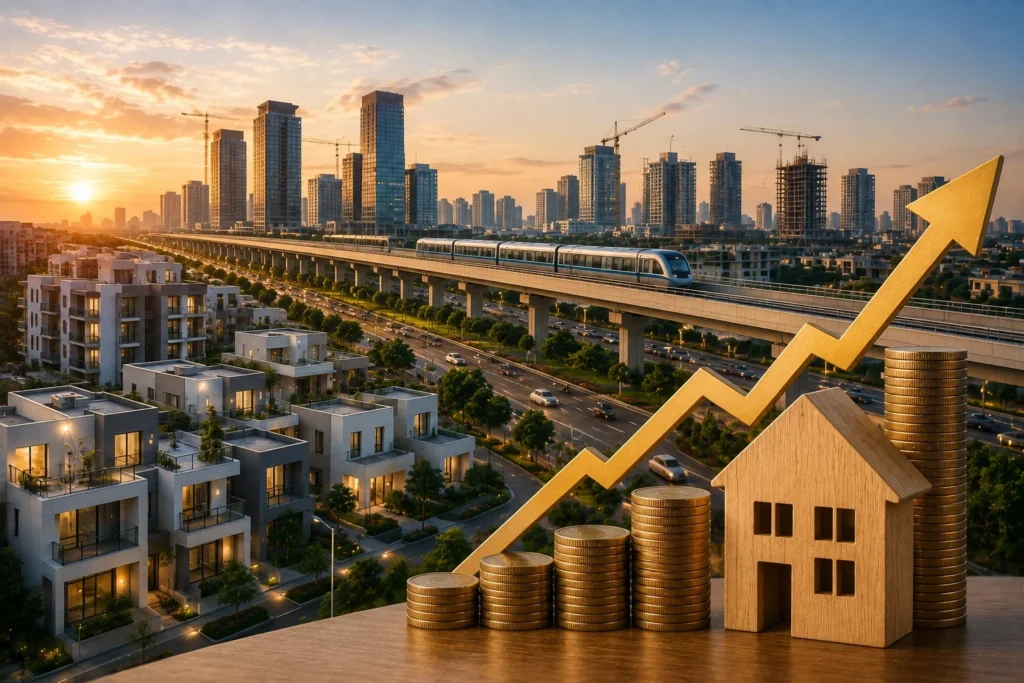
When an area becomes easier to access and attracts more residents or businesses, rental demand may increase. This can create opportunities for landlords and investors.
At the same time, investors may anticipate future appreciation and become more interested in land or property located along developing corridors.
However, investors should distinguish between potential and guaranteed returns. Infrastructure is one factor among many that influence real estate performance.
Property prices can also be affected by interest rates, economic conditions, oversupply, legal approvals, construction quality, local demand, and broader market sentiment.
8. Not Every Infrastructure Project Raises Property Values
It is important not to assume that infrastructure development always produces positive results.
A project can sometimes reduce the appeal of a property if it creates excessive traffic, noise, pollution, congestion, or construction disruption.
For example, a property located directly beside a heavily congested road may face disadvantages even though the broader neighborhood benefits from improved connectivity.
The quality, location, design, and purpose of the project therefore matter.
Investors should also verify whether a proposed infrastructure project is officially approved, funded, and progressing according to schedule rather than making decisions based solely on advertisements or market rumors.
How Should Investors Evaluate Infrastructure-Driven Property Opportunities?
Before buying property near an infrastructure project, consider the following factors:
- Project status: Check whether the project is proposed, approved, under construction, or operational.
- Distance: Evaluate the property’s actual travel distance rather than relying only on marketing claims.
- Connectivity: Determine which major roads, employment centers, commercial areas, and public facilities will become easier to access.
- Development potential: Look for evidence of genuine residential, commercial, or industrial activity.
- Demand: Check whether people are actually buying or renting properties in the area.
- Legal status: Verify ownership, approvals, documentation, and relevant development permissions.
- Negative effects: Consider traffic, noise, flooding, pollution, and construction disruption.
- Long-term potential: Focus on sustainable demand rather than short-term speculation.
Frequently Asked Questions (FAQs)
1. Do infrastructure projects increase property values?
Yes, infrastructure projects can increase property values when they improve accessibility, reduce travel time, attract economic activity, and increase demand. However, the impact varies by location and project type.
2. Which infrastructure projects have the biggest impact on property prices?
Roads, highways, interchanges, public transport, airports, railway connections, and major commercial or economic developments can influence property prices. Their impact depends on how much they improve accessibility and local demand.
3. How do roads affect property values?
Better roads can improve accessibility and reduce travel time, making nearby properties more attractive to buyers, tenants, and businesses. Evidence from Karachi’s M-9 Motorway study found that proximity to the road infrastructure project was associated with changes in property prices, rents, and land development.
4. Should I buy property near an upcoming infrastructure project?
An upcoming project may create future investment potential, but buyers should verify its approval, funding, construction progress, location, and expected impact before investing. Infrastructure alone is not a guarantee of property appreciation.
Conclusion
Infrastructure and real estate are closely connected because better infrastructure can change the accessibility and economic importance of a location. Roads, highways, public transport, utilities, airports, and other development projects can attract residents, businesses, and investors, creating stronger demand for surrounding properties.
For property investors, the key is not simply to find an area with an infrastructure project. The better strategy is to understand how the project will change accessibility, demand, economic activity, and the overall quality of the location.
When these factors come together, infrastructure development can become an important driver of property value growth and long-term real estate investment potential.


