

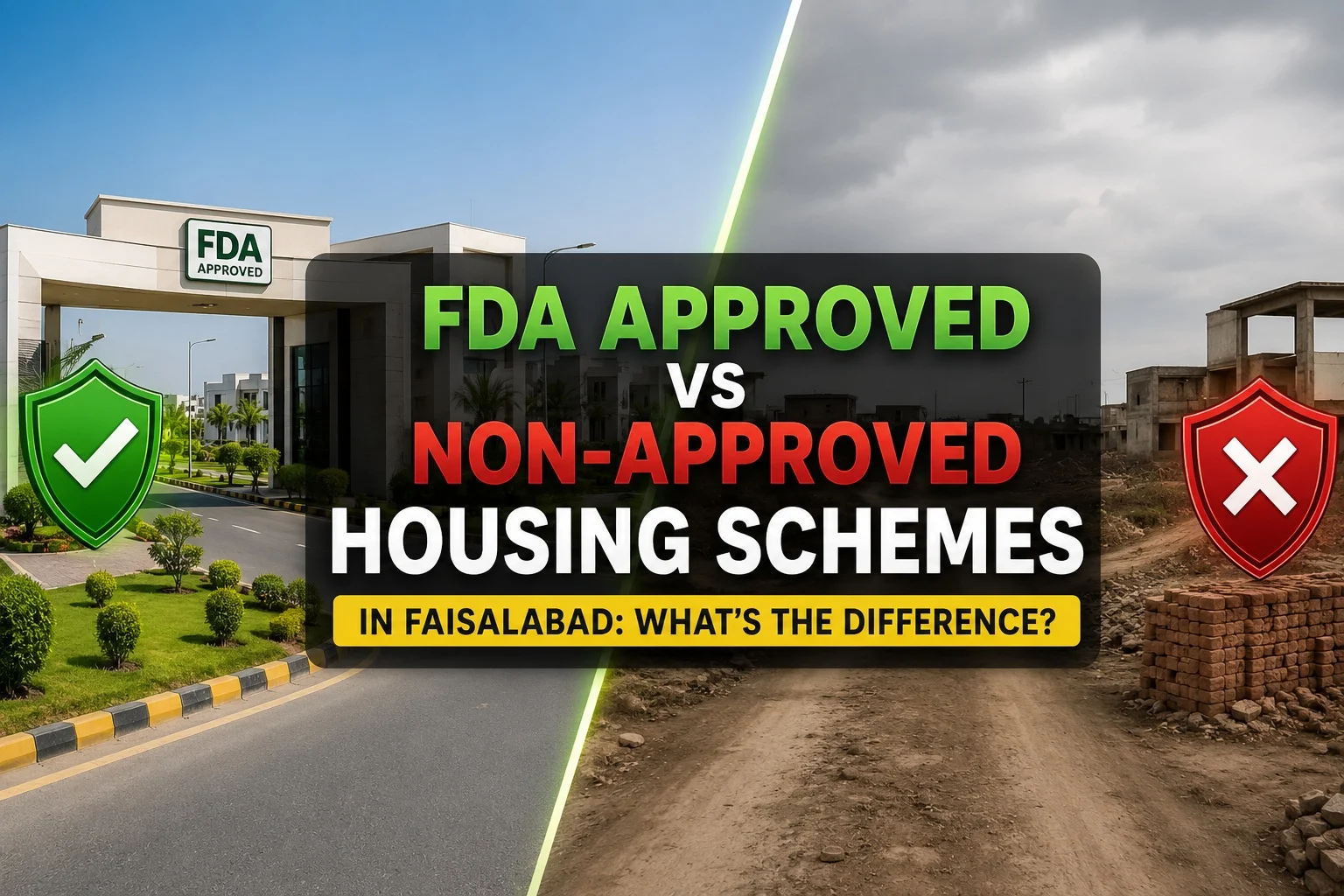
Buying a plot or house is a major financial decision, especially when investing in a growing city like Faisalabad. With many housing societies offering plots on cash and installment plans, buyers often focus on price, location and development. However, understanding the difference between FDA approved vs non-approved housing schemes in Faisalabad is equally important. Before making an investment, buyers should always check the legal status of the housing scheme to avoid potential financial and legal problems.
The Faisalabad Development Authority (FDA) is responsible for regulating and approving private housing schemes in the city. Housing schemes can have different statuses, including approved, under process and illegal. Understanding these differences can help buyers avoid financial and legal problems.
What Is an FDA Approved Housing Scheme?
An FDA approved housing scheme in Faisalabad is a private housing development that has received the required approval from the Faisalabad Development Authority.
Approval indicates that the housing scheme has gone through the relevant regulatory and planning process. The approved plan may cover matters such as the layout of the society, residential and commercial areas, roads, public facilities and other development requirements.
For property buyers, an approved status provides an important level of confidence. However, buyers should remember that approval of a housing society does not automatically guarantee that every individual plot is free from legal or ownership issues.
Before purchasing a plot, buyers should still verify the plot number, ownership documents, location, size, development status and other relevant records.
What Is a Non-Approved Housing Scheme?
A non-approved housing scheme is a development that has not received the required approval from the relevant authority.
However, buyers should understand that non-approved does not always mean exactly the same thing as illegal. Some housing schemes may be under process, meaning their approval application or related requirements are still being considered.
An illegal housing scheme, on the other hand, does not have the required authorization to operate as an approved private housing development.
This distinction is important because buyers should not assume that a society is approved simply because its developer claims that approval is “under process” or expected soon.
FDA Approved vs Non-Approved Housing Schemes
The main difference between the two is their regulatory status and the level of risk involved.
An FDA approved housing scheme has completed the relevant approval process, while a non-approved scheme does not have the same regulatory standing.
For buyers, the differences can include:
- Legal status: Approved societies have the required regulatory approval, while non-approved schemes do not.
- Investment risk: Non-approved schemes generally carry greater legal and financial uncertainty.
- Development: Approved projects are expected to follow their approved planning and development requirements.
- Infrastructure: Non-approved or illegal schemes may face difficulties with basic services and development.
- Resale: Properties in legally recognized schemes may provide greater confidence to future buyers.
- Verification: Buyers can check the official status of an approved housing scheme before investing.
This does not mean that every approved scheme is automatically a perfect investment. Location, development quality, price and individual plot documentation still matter.
Why Does FDA Approval Matter?
FDA approval matters because it helps buyers determine whether a housing society has gone through the required regulatory process.
Imagine two societies offering plots at similar prices. One has verified FDA approval, while the other is being marketed as “soon to be approved.” Choosing the cheaper option may seem attractive, but the second investment could involve considerably more uncertainty.
Approval can also make it easier for buyers to assess the development according to its approved plan.
For someone planning to build a home, legal status is particularly important. Buyers need confidence that the society can develop and provide the necessary infrastructure in accordance with applicable requirements.
Risks of Buying in Non-Approved Housing Schemes
The biggest attraction of non-approved housing schemes is often their lower prices or flexible installment plans. But a lower price can come with significant risks.
Legal Uncertainty
An illegal or unauthorized housing scheme may face regulatory action. This can create serious problems for people who have already purchased plots.
Development Problems
Roads, drainage, water supply, electricity and other facilities may not be developed as expected. Delays can make it difficult for residents to build or occupy their properties.
Resale Difficulties
A property with an uncertain legal status can be difficult to resell. Potential buyers may hesitate to purchase a plot if they cannot verify the housing scheme’s approval.
Financial Loss
If a housing scheme faces legal or development problems, investors may have difficulty recovering their money. A low purchase price does not necessarily mean a low-risk investment.
Possession Issues
Some buyers purchase plots expecting possession within a specific period. If a scheme has approval or development issues, possession may be delayed significantly.
How to Check FDA Approval Before Buying Property

Before investing in a housing society in Faisalabad, buyers should conduct proper verification.
1. Check the Society’s Status
Start by checking the housing scheme’s current status with the relevant authority. Do not rely solely on information provided by a property dealer or developer.
2. Confirm the Approval
If the society claims to be approved, verify that approval through official records. Ask for the relevant approval documents if necessary.
3. Check the Approved Layout Plan
The approved layout is important because it shows how the housing scheme has been planned. Buyers should confirm that the plot they are purchasing is actually part of the approved development.
4. Verify Land Ownership
Housing-scheme approval and individual plot ownership are two different matters. Buyers should verify the seller’s ownership and relevant land records before completing the transaction.
5. Check the Plot Details
Confirm the plot number, block, size, location and development status. Make sure the information provided by the seller matches the official documentation.
6. Get Legal Advice
For a major property investment, consulting a qualified property lawyer can be worthwhile. Professional verification may identify ownership disputes, documentation problems or other risks before money changes hands.
Don’t Confuse “Under Process” With “Approved”
One of the most important things for property buyers to understand is the difference between approved and under process.
A developer may tell potential buyers that a housing scheme has applied for approval or that approval is expected soon. However, an application does not mean that approval has already been granted.
Buyers should therefore verify the current status instead of relying on statements such as “approval is coming,” “all paperwork has been submitted” or “the society will be approved soon.”
Until official approval is confirmed, buyers should consider the investment carefully.
Why Property Buyers Should Not Rely Only on Advertisements
Property advertisements usually highlight attractive features such as prime locations, affordable prices, easy installments and high expected returns. While these details may be useful, they do not establish the legal status of a housing scheme.
Before paying a booking amount or down payment, buyers should independently verify the society and property.
This is especially important when a developer is offering plots at prices significantly below similar properties in the surrounding area. A bargain may look attractive initially, but hidden legal or development problems can make the investment much more expensive in the long run.
What Should Buyers Check Before Investing?
A simple checklist can help Faisalabad property buyers make a more informed decision:
- FDA approval status
- Approved layout plan
- Land ownership
- Plot number and size
- Development progress
- Possession status
- Road access
- Availability of basic utilities
- Seller or developer documentation
- Any known legal disputes
- Payment and transfer procedures
- Future resale potential
Taking these steps before purchasing can reduce the chances of making a costly mistake.
Frequently Asked Questions (FAQs)
1. What is the difference between FDA approved and non-approved housing schemes in Faisalabad?
An FDA-approved housing scheme has received the required regulatory approval, while a non-approved scheme does not have the same approved status. Buyers should verify the scheme’s current status before investing.
2. How can I check if a housing scheme is FDA approved in Faisalabad?
You can check the housing scheme’s status through the Faisalabad Development Authority’s official records. Confirm that the scheme is listed as approved rather than under process or illegal.
3. Is it safe to buy a plot in a non-approved housing scheme in Faisalabad?
Buying a plot in a non-approved or illegal housing scheme carries higher legal, development and financial risks. Buyers should verify approval before making any payment.
4. What are the risks of investing in an illegal housing scheme in Faisalabad?
Potential risks include legal issues, delayed development, problems with utilities and possession, resale difficulties and possible financial loss.
5. Does FDA approval guarantee that a plot is safe to buy?
No. FDA approval relates to the housing scheme, but buyers should separately verify the individual plot’s ownership, location, documents, development status and any possible disputes.
Conclusion
The difference between FDA approved and non-approved housing schemes in Faisalabad is not simply about a label. It can have a direct impact on the legal security, development prospects and investment risk associated with a property.
An approved housing scheme has gone through the relevant regulatory process, while a non-approved or illegal scheme may expose buyers to greater uncertainty. Similarly, a scheme that is under process should not automatically be considered approved.
For anyone planning to buy a plot or house in Faisalabad, the safest approach is to verify the housing scheme’s current status first and then conduct separate due diligence on the individual property.
A good location and attractive price are important, but legal verification should always come before making a property investment.


