

Buying property in a housing society can be a major financial decision. A well-planned and legally approved society may offer better infrastructure, amenities, and resale potential. However, buyers can face serious financial and legal problems if they purchase a plot in an unapproved scheme or fail to verify important documents.
Before paying a booking amount or signing a sale agreement, buyers should check the housing society’s approval status, NOC, layout plan, land ownership, plot details, development status, and transfer documents. This guide explains the key housing society regulations and verification checks buyers should consider before purchasing property.
1. Verify the Housing Society’s Approval Status
The first step is to determine whether the housing society is legally approved by the relevant development authority.
The responsible authority depends on the property’s location. For example, the Faisalabad Development Authority provides rules and requirements for the approval of private housing schemes, while other areas may fall under authorities such as LDA, RDA, CDA, or another competent local authority.
Do not rely solely on a developer’s brochure, property dealer, social media advertisement, or verbal claim that a society is “approved.” Buyers should also understand how the latest Punjab housing rules affect property purchases and buyer protections. Check the authority’s official records and confirm the exact name, location, phase, and status of the scheme.
2. Check the Housing Society NOC
A No Objection Certificate (NOC) is one of the most important things to verify before buying property in a housing society.
However, buyers should understand that layout plan approval and NOC are not necessarily the same thing. For example, CDA explains that private schemes go through a two-step approval process in which the Layout Plan (LOP) is approved first and, after subsequent formalities, an NOC for development is issued.
Therefore, if a developer says that a project is “approved,” ask exactly what has been approved.
Check:
- NOC status
- Approved land area
- Exact phase or block covered
- NOC number and issuing authority
- Current status of the approval
- Any cancelled, revised, or pending portions
This is particularly important when a society has launched an extension or a new block that may not have the same approval status as its original area.
3. Compare the Approved Layout Plan
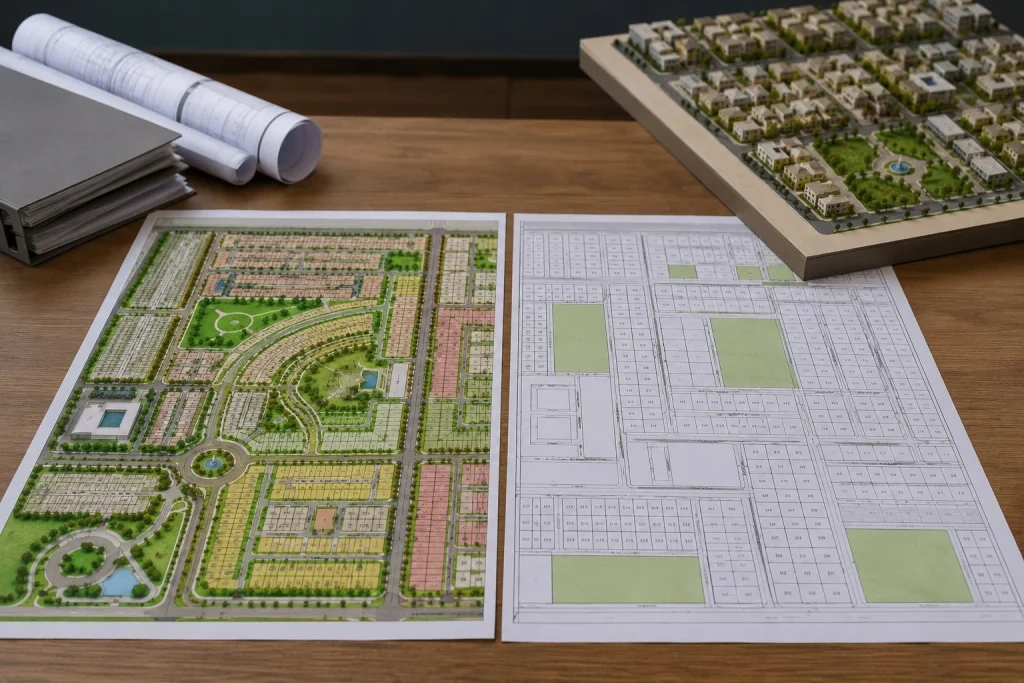
An approved layout plan shows how the housing scheme is planned and where residential plots, roads, parks, commercial areas, and other facilities are located.
Before purchasing, compare the developer’s marketing map with the officially approved layout plan. Check whether the block and plot being offered actually fall within the approved boundary.
This matters because approval of one portion of a housing scheme does not automatically mean that every extension or newly marketed block is approved. Official regulatory records can distinguish between different approval statuses.
Buyers should pay particular attention to:
- Plot number
- Block name
- Plot size
- Road location
- Approved boundaries
- Parks and public-use areas
- Commercial areas
- Proposed infrastructure
If the seller cannot clearly match the plot to the approved plan, pause the transaction until the matter is independently verified.
4. Verify Land Ownership
Housing society approval should not be treated as a substitute for checking land ownership.
Buyers should investigate whether the developer or seller has valid rights over the land connected to the property. Depending on the location and transaction, relevant documents may include title records, registry documents, mutation records, allotment documents, and transfer papers.
Land ownership and development approval are separate issues. A buyer should therefore verify both before making a substantial payment.
Where ownership documents are complicated or there is a previous transfer history, getting independent legal advice can help identify potential disputes, mortgages, restrictions, or gaps in the title chain.
5. Check Whether the Plot Is Actually Available
A housing society may be approved while an individual plot still has documentation or transfer issues.
Before purchasing, verify the:
- Plot number
- Block
- Size
- Category
- Allotment status
- Ownership or seller’s authority
- Transfer eligibility
- Outstanding dues
You should also confirm whether the plot is mortgaged, disputed, already allotted to someone else, or subject to another restriction.
CDA’s property verification information, for example, highlights issues such as mortgage plots, changes to approved planning specifications, and misuse of public amenities as matters that may require attention.
6. Review the Society’s Development Status

Legal approval is important, but buyers should also examine the actual development of the area.
Check whether the society has adequate:
- Roads and streets
- Water supply
- Sewerage
- Electricity
- Drainage
- Street lighting
- Parks
- Other promised amenities
A society may advertise future infrastructure, but buyers should distinguish between planned development and completed development.
Visit the site personally if possible. Compare what you see on the ground with the approved plan and the developer’s claims.
7. Examine Property and Transfer Documents
Before completing the transaction, carefully review all relevant documents.
Depending on the property and transaction, these may include:
- CNIC and seller identification
- Allotment letter
- Transfer letter
- Possession letter
- Sale agreement
- Site plan
- Society NOC
- Payment receipts
- Ownership/title records
- Mortgage release documents, where applicable
Official checklists can vary by authority and transaction type. For example, LDA’s checklist for approved private housing schemes includes documents such as transfer and possession letters, site plans, society NOCs, and mortgage release documentation where applicable.
Do not sign documents you do not understand. If necessary, have the agreement reviewed by a qualified property lawyer.
8. Find Out About Additional Charges
The advertised property price may not represent the total amount you will eventually pay.
Ask the society or seller for a written breakdown of all applicable charges, including:
- Development charges
- Transfer fees
- Possession charges
- Utility charges
- Membership fees
- Documentation charges
- Outstanding dues
Understanding the complete cost before booking can help prevent unexpected expenses later.
9. Check for Legal Disputes and Red Flags
Buyers should investigate whether the housing society or the specific property has any known legal problems.
Be cautious if you encounter:
- “NOC in process” claims
- Pressure to book immediately
- Missing ownership documents
- Unclear plot location
- Large differences between marketing and approved maps
- Unusually low prices
- Promises of guaranteed returns
- Unverified screenshots showing approval
- Newly launched extensions without clear approval
Regulatory authorities themselves warn buyers against investing in illegal or unapproved housing societies and advise checking current status through official sources rather than relying on circulated screenshots or claims.
10. Verify Before Paying the Booking Amount
One of the biggest mistakes buyers make is paying a token or booking amount first and conducting verification later.
A safer approach is to complete the basic checks before committing significant money. Confirm the society’s legal status, NOC, approved layout, land ownership, plot details, development status, and seller documentation.
If information from the developer, dealer, and government authority does not match, do not proceed until the discrepancy has been resolved.
Housing Society Buyer Checklist
Before purchasing property, buyers should verify:
- Housing society approval status
- Valid NOC and issuing authority
- Approved layout plan
- Exact phase and block
- Land ownership
- Plot number and size
- Seller’s ownership or transfer authority
- Development and infrastructure
- Utility availability
- Transfer and allotment documents
- Outstanding charges
- Litigation or other legal restrictions
Frequently Asked Questions (FAQs)
1. What should buyers check before purchasing property in a housing society?
Buyers should verify the society’s approval status, NOC, approved layout plan, land ownership, plot details, development status, transfer documents, outstanding charges, and any legal disputes.
2. How can I verify if a housing society is legally approved?
Check the housing society’s current approval status through the relevant development authority. Verify the exact society name, phase, block, approved area, and NOC rather than relying only on a dealer or developer.
3. Why is a housing society NOC important for property buyers?
A housing society NOC indicates that the relevant authority has granted required regulatory clearance for the scheme or its development. Buyers should verify the NOC directly with the issuing authority.
4. What documents should I check before buying a plot in a housing society?
Important documents may include the allotment letter, transfer letter, possession letter, sale agreement, approved layout plan, ownership records, payment receipts, and relevant NOCs or approval documents.
5. What are the red flags when buying property in a housing society?
Common red flags include unclear approval status, missing ownership documents, an NOC that cannot be independently verified, plots outside the approved layout, pressure to book quickly, unusually low prices, and unclear development or transfer terms.
Conclusion
Understanding housing society regulations can help buyers avoid costly property mistakes. Approval status, NOC verification, the approved layout plan, land ownership, plot documentation, development progress, and transfer requirements should all be checked before purchasing.
Most importantly, buyers should not assume that an advertisement or dealer’s statement proves a property’s legal status. Verify information through the relevant authority and examine the property’s documents independently.
A few hours of careful property verification and due diligence can help protect a buyer from much larger financial and legal problems in the future.


